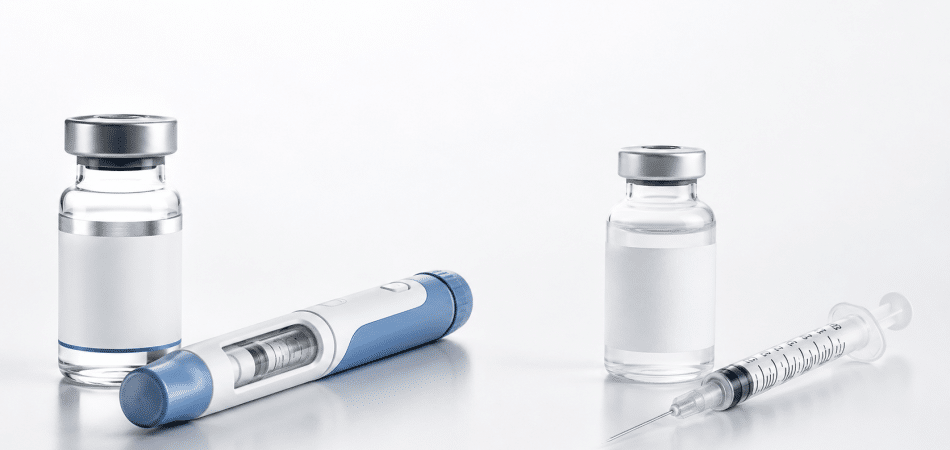
Compounded and branded tirzepatide contain the same active ingredient and work the same way in your body, so the difference is not the drug itself. It is everything around the drug. Branded Zepbound and Mounjaro are FDA-approved, trial-tested, and made on a manufacturer’s line, while compounded tirzepatide is prepared by a state-licensed pharmacy for one patient, is not FDA-reviewed, and is legal only under specific medical conditions.
If you have shopped for tirzepatide, you have seen the same molecule sold two very different ways. One comes as a brand-name pen with an FDA label, and the other comes compounded by a pharmacy under a far narrower set of rules.
The active ingredient is identical, so the comparison gets confusing fast, even though the real differences sit in approval, manufacturing, evidence, and access. At Harmonia Health Solutions, we walk patients through that comparison so the choice is medical rather than guesswork.
This guide lays out what the two share, where they genuinely differ, and how access and legality factor in. Contact us today to talk through which version fits your health with a licensed provider.
Start with the part that is genuinely the same, because it is the source of most of the marketing confusion. Both versions are built on the same molecule and behave the same way once they are in your body.
Tirzepatide is a dual GLP-1 and GIP receptor agonist, and that chemistry does not change based on who prepares it. Whether it arrives as branded Zepbound or as a compounded vial, it curbs appetite, increases fullness, and slows how quickly your stomach empties.
The dosing rhythm is shared too, since both are once-weekly subcutaneous injections that start low and step up over time. Both also carry the same common side effects, mostly digestive ones like nausea that ease as your body adjusts.
That common ground is real, but it is also where the similarities stop, and you can compare both routes through our compounded tirzepatide program with a provider who knows your history.
The molecule is the same, so the meaningful differences are about approval, production, evidence, and flexibility. These four are where your decision actually gets made.
 This is the headline difference. Branded Zepbound is FDA-approved for chronic weight management, and Mounjaro is FDA-approved for type 2 diabetes, which means each went through the agency’s full review for safety, efficacy, and quality.
Compounded tirzepatide carries no such approval. The FDA does not review compounded medications for safety, efficacy, or quality, so the oversight comes from state pharmacy boards and the prescribing provider rather than from a federal approval. That federal review is also why a branded prescription comes with a consistent, tracked supply chain from the factory to your pharmacy.
Branded tirzepatide is produced on Eli Lilly’s tightly controlled manufacturing lines, where every batch follows standardized, federally inspected processes. The pen you receive is identical to the one used in clinical trials, and one batch matches the next, no matter where you fill it.
Compounded tirzepatide is prepared by a state-licensed compounding pharmacy, usually one prescription at a time. Quality depends heavily on that specific pharmacy’s standards, which is why the source and the oversight behind a compounded product matter so much.
Reputable pharmacies test their preparations, but those standards are not uniform across every facility, so the pharmacy you use carries real weight.
Branded tirzepatide has a deep trial record. In Eli Lilly’s SURMOUNT-1 study, adults on the highest dose lost 20.9 percent of their body weight over 72 weeks, a result published in the New England Journal of Medicine.
In Eli Lilly’s SURMOUNT-5 head-to-head trial, branded tirzepatide produced greater total weight loss than semaglutide, which is part of why demand for it runs so high. Compounded tirzepatide, by contrast, has no trials of its own.
It relies on the same active ingredient, so its effect is presumed to track the branded data, but that presumption is not the same as dedicated evidence, and honest providers say so plainly.
Here is where compounding has a legitimate edge for some patients. Branded pens come in fixed doses, while a compounding pharmacy can prepare a strength or formulation that the standard pen does not offer.
That flexibility is the real medical reason compounding exists, such as a patient who needs a dose between the standard steps or who reacts to an inactive ingredient.
For most patients, though, the standard pen doses are exactly what a provider would prescribe anyway, so the flexibility only matters in specific cases. It is a clinical tool for those situations, not a blanket upgrade over the branded product.
Access and legality are usually what tip a decision, and both have shifted a lot recently. Branded offers certainty and a standard prescription, while compounded now sits in a much more restricted space than it once did.
 Branded Zepbound and Mounjaro are available with a standard prescription, filled at a regular pharmacy like any other FDA-approved medication.
Whether a plan covers them varies widely, since many cover tirzepatide for diabetes but not for weight management. Checking your own plan’s formulary is the fastest way to see where you stand.
Because coverage and availability shift over time, the safest move is to confirm the current details with a provider before deciding. You can review Zepbound through our practice to see how the branded route works with a licensed provider.
Compounded tirzepatide is not billed through insurance, so getting it depends on a provider and a pharmacy rather than on a plan’s approval. That independence is part of why it drew so much attention during the shortage, when branded supply was hard to find. The active ingredient is the same either way, so the real difference here is how you reach it and whether the rules allow it.
The trade-off is that going around the branded product also means going without FDA oversight and trial-backed consistency. Convenience alone is not a legal reason to choose compounding, which leads directly to the access question. It can be the right call for a specific patient, but only after a provider confirms the medical and legal basis for it.
Access changed sharply after the FDA declared the tirzepatide shortage resolved in October 2024. Through 2025, the agency wound down the leeway that had allowed widespread compounding, and in April 2026, it proposed restricting bulk compounding even further.
What remains is a narrow lane for state-licensed pharmacies to compound tirzepatide for an individual patient with a valid prescription and a documented clinical need. A documented need means something like an allergy to an inactive ingredient or a dose the commercial pen does not make, not simply a preference for a different route. A licensed provider has to make that call, which is part of how our telehealth process works.
Here is the whole comparison in one view, so the trade-offs are easy to scan before you talk to a provider.
For most patients who qualify for the branded product, the FDA-approved route offers the most certainty. Compounded tirzepatide makes the most sense in the narrow cases where a documented clinical need, like a non-standard dose, justifies it, and a licensed provider is the one who weighs that for you.
Neither route is automatically better, because the right answer depends on your health, your coverage, and whether you have a clinical reason that compounding actually addresses.
The honest answer is that the better option depends on your clinical picture, not on a label or a quick comparison, and that decision belongs with someone who knows your history. The branded route offers approval and evidence, while compounding solves specific problems that the standard pen cannot.
At Harmonia Health Solutions, we help you weigh both routes against your health, your goals, and what the current rules actually allow. Call us today to compare compounded and branded tirzepatide with a licensed provider and choose with confidence.
Medical Disclaimer: For informational purposes only. This article does not constitute medical advice. Compounded tirzepatide is not reviewed or approved by the FDA for safety, efficacy, or quality, and a state-licensed pharmacy may prepare it only for an individual patient when a licensed medical provider determines it is medically necessary. Individual results vary. Consult a licensed provider before starting any new medication or weight-loss program.
They contain the same active ingredient but differ in almost everything else. Branded Zepbound and Mounjaro are FDA-approved, trial-tested, and made by the manufacturer, while compounded tirzepatide is prepared by a state-licensed pharmacy for an individual patient, is not FDA-reviewed, and is available only under limited clinical conditions.
It uses the same active ingredient, so its effect is presumed to be similar, but it has no clinical trials of its own to confirm that. Branded tirzepatide has documented trial results, while compounded versions rely on that branded data rather than dedicated studies. A licensed provider can explain what this means for you.
No. Compounded tirzepatide is not billed through insurance, so it does not depend on a plan approving it. Access instead depends on a licensed provider determining it is appropriate for you and a state-licensed pharmacy being able to fill the prescription, which is only allowed under specific clinical conditions.
Branded tirzepatide is FDA-reviewed for safety and quality, while compounded tirzepatide is not, so its safety depends heavily on the pharmacy and the medical oversight behind it. When prescribed by a licensed provider and filled by a reputable state-licensed pharmacy, the active ingredient matches the branded drug, but the lack of FDA review is a real difference.
It shares the same active ingredient as Mounjaro, but it is not the same product. Mounjaro is the FDA-approved, manufacturer-made version indicated for type 2 diabetes, while compounded tirzepatide is custom-prepared by a pharmacy and is not FDA-reviewed or approved for any use.
Usually because of a documented clinical reason the branded pen cannot meet, such as a needed dose that falls between the standard steps or a reaction to an inactive ingredient. Compounding exists to solve those specific situations, not to serve as a routine substitute for an available FDA-approved product.
Branded tirzepatide is fully legal and FDA-approved, while compounded tirzepatide is legal only in narrow cases. After the FDA declared the shortage resolved, broad compounding ended, and a state-licensed pharmacy may now compound it only for an individual patient with a valid prescription and a documented clinical need.
Start with a licensed provider who reviews your health history, goals, insurance, and whether you have a clinical reason that compounding would address. For most people who qualify, the FDA-approved branded route offers the most certainty, and a provider can confirm which option is appropriate and legal for your situation.

At Harmonia Health Solutions, your privacy and safety are our top priorities. We comply with HIPAA regulations to ensure that your personal information is protected, and our consultations are conducted by licensed healthcare professionals who adhere to the highest medical standards.
You’ll find information about longevity products and alternative health services, as well as news regarding the most recent holistic health and wellness research.